
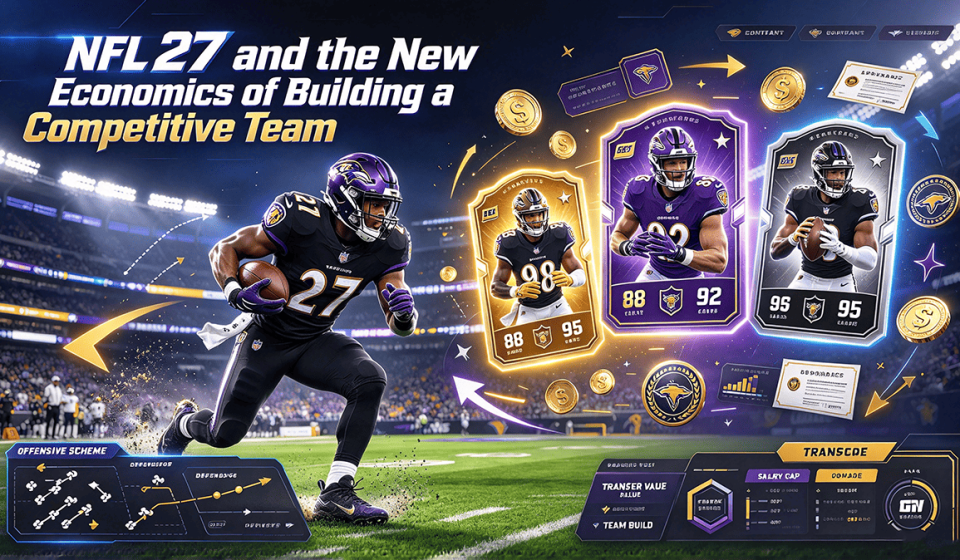
NFL 27 and the New Economics of Building a Competitive Team
Every new football game eventually reaches the same point: the excitement of building a team turns into the much more complicated question of how to manage resources.
NFL 27 is no different. Whether you are starting a fresh Ultimate Team lineup, experimenting with different player combinations, or trying to keep up with new content, the in-game economy has become an important part of the experience. Coins are not simply another number on the screen. They influence which players you can test, how quickly you can adjust your roster, and how much flexibility you have when the competitive meta changes.
That is why conversations around buy NFL 27 Coins continue to attract attention among players who want to spend less time worrying about resource shortages and more time actually playing.
Team Building Is Becoming an Economic Game
Modern football games are no longer just about finding the highest-rated players.
A competitive roster requires balance. A quarterback might be the centerpiece, but weaknesses at offensive line, secondary, linebacker, or special teams can quickly become obvious once you start playing against stronger opponents.
This creates an interesting economic problem.
Do you spend most of your coins on one elite player? Do you spread your budget across several positions? Should you hold resources for upcoming content instead of upgrading immediately?
Experienced players usually learn that the answer depends on the stage of the game. A card that looks extremely valuable during one content cycle can become less attractive after a new program changes the available player pool.
Managing coins therefore becomes part of the strategy rather than something separate from gameplay.
Why Coins Matter More as the Content Expands
One of the most interesting trends in Ultimate Team-style modes is how quickly the available content can expand.
New programs, player releases, challenges, objectives, packs, and market opportunities create constant movement. Even players who are perfectly happy with their existing roster can suddenly find themselves considering an upgrade when a new card fits their preferred scheme.
That makes liquidity valuable.
Having coins available gives players the ability to react instead of committing everything to a single purchase. It also makes experimentation easier. You can try a different offensive setup, replace a weak position, or build around a newly released player without completely rebuilding your team from scratch.
For players researching buy NFL 27 Coins, this is probably the more useful way to think about the topic: not as a shortcut to winning, but as part of a broader conversation about time, resources, and roster management.
The Market Rewards Patience
There is another lesson that becomes obvious after spending enough time with team-building modes: not every purchase needs to happen immediately.
New cards often receive plenty of attention when they first arrive. Demand can push prices upward, while later supply and changing player preferences can alter the market.
That means patient players may sometimes benefit from waiting.
Instead of spending coins simply because a new card looks exciting, it can be worth asking whether the player actually improves your scheme. A high overall rating does not automatically make a card more useful for every roster.
This is where experienced players tend to separate themselves from impulse buyers. They look at attributes, abilities, position requirements, chemistry or lineup interactions, and the opportunity cost of spending coins elsewhere.
The Changing Meaning of Progression
NFL 27 also reflects a larger trend across sports games: progression is increasingly about managing several systems at once.
There is gameplay progression, roster progression, market progression, and personal progression.
You might improve because you became better at reading defenses. You might improve because you finally found a player that fits your play style. Or you might improve because you managed your resources well enough to make several smart roster changes over time.
The most interesting teams are often not the ones assembled in a single afternoon. They are the result of dozens of smaller decisions.
That makes resource management surprisingly close to roster construction in real football. Coaches and general managers constantly work with limited resources, balancing immediate needs against future flexibility.
Where EZBUFF Fits Into the Conversation
For players researching ways to manage their NFL 27 experience, EZBUFF can be part of that wider resource conversation.
The important thing is to approach any external coin-related service carefully. Players should check platform requirements, delivery policies, account-security considerations, and the game’s own rules before making a decision.
Ultimately, resources are most useful when they support an actual team-building strategy.
Buying coins without knowing what you want to do with them can simply lead to another round of inefficient spending. Having a clear roster plan first is usually more valuable: identify your weak positions, establish a preferred scheme, decide which upgrades matter most, and then determine how much additional currency you actually need.
The Future of Team Building
The economy surrounding football games is becoming almost as interesting as the gameplay itself.
Players now discuss market timing, card value, roster flexibility, program cycles, and resource efficiency alongside formations and playbooks. That is not necessarily a bad thing. It gives team-building modes another layer of strategy and creates different ways for players to approach the same game.
NFL 27 sits comfortably inside that evolution.
For some players, the fun is building a competitive roster as efficiently as possible. For others, it is collecting favorite players or experimenting with unusual lineups. And for many, it is the long-term process of watching an ordinary roster gradually become something personal.
The real value of coins is therefore not simply what they can buy. It is the freedom they provide to make those decisions when the next interesting opportunity appears.